KEY TAKEAWAYS
- The Act and its regulations commenced on 31 March 2022, replacing the Occupational Safety and Health Act 1984.
- Four groups hold duties: PCBUs, officers, workers and others at the workplace.
- Health expressly includes psychological health.
- Officers carry a personal due diligence duty they can’t delegate.
- Industrial manslaughter carries a maximum $10 million fine for a company.
What changed when the WHS Act 2020 started
The Work Health and Safety Act 2020 and its accompanying regulations came into effect on 31 March 2022, according to WorkSafe WA’s guidance on the state’s WHS laws. The Act replaced the Occupational Safety and Health Act 1984 and pulled general industry, mining and petroleum operations under a single WHS Act for the first time.
Three sets of regulations sit underneath it: the General Regulations 2022 for most workplaces, the Mines Regulations 2022, and the Petroleum and Geothermal Energy Operations Regulations 2022.
CITATION CAPSULE Western Australia moved onto the national model WHS laws a decade after the eastern states, and the change was more than a rename. Employers became PCBUs, employees became workers, and section 4 now defines health to cover psychological as well as physical health. |

Who holds a duty under the WHS Act
Four groups carry duties under Part 2 of the work health and safety act WA. Sections 14 to 16 make the structure clear: a duty can’t be transferred, one person can hold more than one duty, and more than one person can hold the same duty for the same risk.
Duty holder | Section | What the Act asks |
PCBU | s19 | Ensure, so far as is reasonably practicable, the health and safety of workers and others affected by the work |
Officer | s27 | Exercise due diligence to ensure the PCBU complies with its duties |
Worker | s28 | Take reasonable care, follow reasonable instructions, cooperate with notified WHS policies |
Other person at the workplace | s29 | Take reasonable care and comply with reasonable instructions |
CITATION CAPSULE A PCBU is the business itself, not a person in a hard hat. Sole traders, partnerships and companies all qualify. Section 7 catches people out: contractors, labour hire staff, apprentices, trainees and volunteers are all your workers, so section 19 reaches every one. |
The primary duty asks for competence, not just equipment
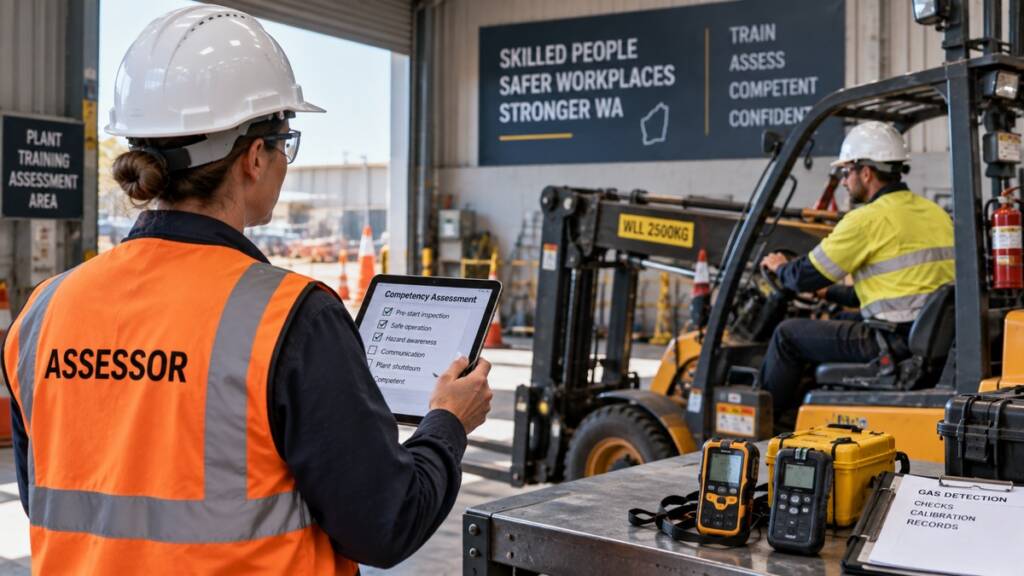
Section 19 lists seven things a PCBU must provide so far as is reasonably practicable. Safe plant, safe systems of work and adequate welfare facilities are three of them. Section 19(3)(f) is the one that turns into a training budget: information, training, instruction or supervision necessary to protect people from risks arising from the work.
Section 18 weighs the likelihood of the hazard, the degree of harm, what you knew or ought to have known, and the cost of control. Cost only counts when it’s grossly disproportionate to the risk. On mine sites, that runs through statutory training approved by the regulator.
CITATION CAPSULE Training isn’t a box you tick once. A qualification proves competence on the day it was issued, which is why many WA sites won’t accept an operator as current without a verification of competency inside the past 24 months. Section 19(3)(g) also asks you to monitor worker health and conditions. |
Officer due diligence, and what non-compliance costs
Section 27 places a personal duty on officers: directors, secretaries and anyone who makes or participates in making decisions affecting a substantial part of the business. Section 27(5) sets out six reasonable steps, and the sixth is the sharpest: verify that safety resources and processes are genuinely used, not just documented.
Section 27(4) allows an officer to be convicted whether or not the business itself is. Penalties run across four tiers in the Act’s official compilation on WA Legislation.
Offence | Individual PCBU or officer | Body corporate |
Industrial manslaughter (s30A) | 20 years imprisonment and $5,000,000 | $10,000,000 |
Category 1 (s31) | 5 years imprisonment and $680,000 | $3,500,000 |
Category 2 (s32) | $350,000 | $1,800,000 |
Category 3 (s33) | $120,000 | $570,000 |
CITATION CAPSULE Category 3 is the tier most WA employers should watch. It needs no injury, no near miss and no harm at all. Failing to comply with a health and safety duty is the whole offence, and it carries up to $120,000 for a PCBU or officer and $570,000 for a company. |
Frequently Asked Questions
No. A SWMS is a specific legal requirement for high risk construction work. A JSA or safe operating procedure doesn’t replace a SWMS where one is required.
Section 28 asks workers to take reasonable care for their own health and safety, take reasonable care that their acts or omissions don’t affect others, follow reasonable instructions so far as they’re able, and cooperate with any notified WHS policy.
Yes. Mining and mineral exploration sit under the same Act, with the Work Health and Safety (Mines) Regulations 2022 layered on top. Those regulations prescribe statutory positions a mine operator must appoint, each with defined functions and competency requirements.
Section 4A ties the definition to the Corporations Act 2001, so it covers directors and secretaries plus anyone who makes or participates in making decisions affecting a substantial part of the business. Influence decides it, not job title.
Where to start
Most of the gap between a compliant WA workplace and an exposed one sits in section 19(3)(f). QPTS is a Registered Training Organisation, RTO #40804, training crews from Perth, Port Hedland and Kalgoorlie. Talk to us about statutory training or a VoC assessment.