Most crews have sat through a toolbox talk that went nowhere. Someone reads a laminated sheet, nobody asks a question, the attendance form gets signed and everyone walks off. Run properly, a toolbox talk is one of the cheapest safety controls you’ve got, and in Western Australia it also helps you meet a legal duty. Here’s what one is, and how to run one people actually listen to.
KEY TAKEAWAYS
- A toolbox talk is a short, informal safety briefing, usually 5 to 15 minutes, run before a shift or task.
- WorkSafe WA lists toolbox talks as a recognised way to meet the consultation duty under the WHS Act 2020.
- Cover one hazard well instead of five badly.
- Manual handling causes 40% of all lost work time in WA (WorkSafe WA), so pick topics that match your real risks.
- Record who attended, what was raised and who owns the follow-up.
What is a toolbox talk?
A toolbox talk is a short safety conversation held at the workplace, usually 5 to 15 minutes, covering one hazard relevant to the work about to start. WorkSafe WA reports a worker’s risk of being fatally injured fell 83% between 1988/89 and 2022/23, and credits a steady rise in day-to-day safety awareness as one driver.
The name comes from crews gathering around the toolbox before work starts. It isn’t a training course and it isn’t a replacement for an induction. It’s a focused, two-way exchange between a supervisor and the people doing the job, aimed at one risk they’ll meet in the next few hours.
Are toolbox talks required in WA?
Not by name, but close to it. The Work Health and Safety Act 2020 places a duty on every PCBU to consult workers on health and safety so far as is reasonably practicable, and WorkSafe WA’s guidance on consulting workers names toolbox talks directly as one of the accepted ways to do it, alongside pre-start briefings and safety committees.
On mine sites the bar sits higher again. The Work Health and Safety (Mines) Regulations 2022 require a mine safety management system that sets out the supervisory structure for WHS at the mine, which makes the supervisor’s daily briefing part of a documented system rather than an optional habit.
A five-step toolbox talk structure
Structure is what separates a briefing from a monologue. WorkSafe WA’s review of the state’s worst hazards found the top twenty hazard groups cost 25,000 years of lost work time across a single decade, which is the case for spending ten minutes properly. Use this as your running order.
Step | Time | What happens |
1. Set the scene | 1 min | Name the task and the one hazard you’re covering |
2. Explain the risk | 2 to 3 min | What can go wrong here, and what it has cost before |
3. Walk the control | 3 to 5 min | Show the control in place, not just the procedure number |
4. Open the floor | 3 to 5 min | Ask what the crew has seen, then let them answer |
5. Close and record | 2 min | Agree the action, name who owns it, sign the record |
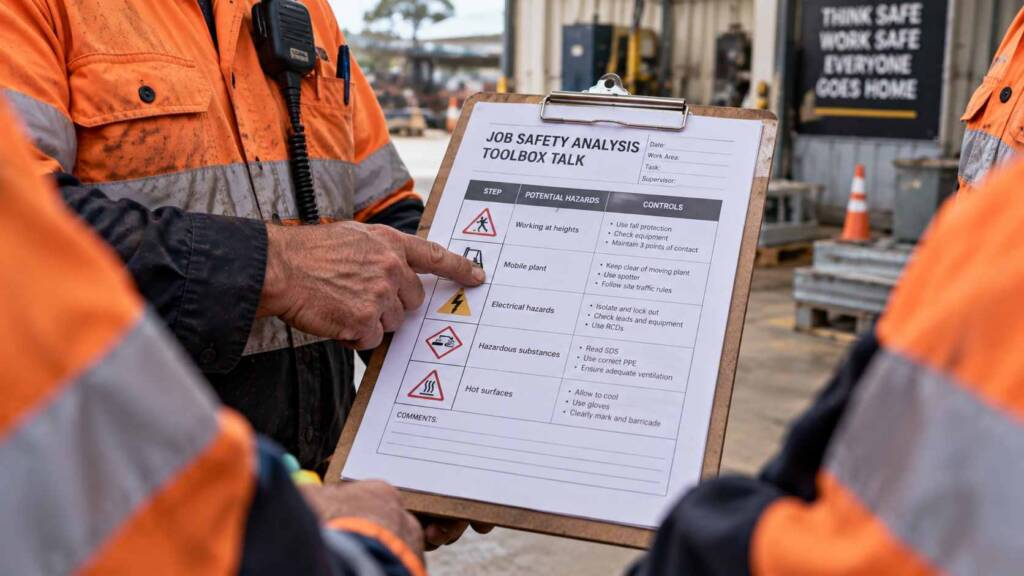
Toolbox talk topics that match real WA risks
Pick topics from your own incident data first, then fill the gaps. Manual handling is the worst hazard group in Western Australia by total time lost, at 40% of the state total, and the single worst specific hazard is trips on clear, cluttered or slick ground. Neither is exotic. Both respond well to a ten-minute conversation.
Hazard group | Toolbox talk angle |
Manual handling | Lift technique, team lifts, and when to stop and get plant |
Housekeeping and trips | Clear ground, cable management, end-of-shift tidy |
Anchor points, ladder set-up, edge protection checks | |
Permits, gas testing, standby person duties | |
Psychosocial risk | Fatigue, workload, bullying and how to report it |
How to run one crews listen to
Frequently Asked Questions
Daily on high-risk sites, weekly as a minimum elsewhere. Run an extra one whenever the work changes, a new crew arrives, an incident or near miss happens, or conditions shift, such as heat, weather or a change of plant.
Usually the supervisor or leading hand running the job. Rotating delivery to experienced crew members lifts engagement, and it’s useful development for anyone heading towards a supervisory or statutory position.
Keep them. A dated record naming the topic, the attendees, the issues raised and the agreed actions is your evidence of consultation, and it’s the first thing an inspector asks for after an incident.
Build the supervisors who can run them
Good toolbox talks come from supervisors who know how to hold the conversation. QPTS is a Perth-based Registered Training Organisation (RTO #40804) delivering nationally recognised leadership and management qualifications, statutory training and high-risk short courses across WA. Talk to our team about training your supervisors.